Tuesday, August 31, 2010

Banteay Srei – citadel of the women

Banteay Srei - Cambodia
Photography – George Mann
Banteay Srei is a 10th century Cambodian temple dedicated to the Hindu god Shiva. Located in the area of Angkor in Cambodia, at 13.5989 N, 103.9628 E, it lies near the hill of Phnom Dei, 25 km (15 miles) north-east of the main group of temples that once belonged to the medieval capitals of Yasodharapura and Angkor Thom.
Banteay Srei is built largely of red sandstone, a medium that lends itself to the elaborate decorative wall carvings which are still observable today. The buildings themselves are miniature in scale, unusually so when measured by the standards of Angkorian construction. These factors have made the temple extremely popular with tourists, and have led to its being widely praised as a “precious gem”, or the “jewel of Khmer art.

Mumbai – City of Renowned Hindu Temples

Mumbai is a city with a milieu of places of worship belonging to different religions and thoughts. It is also a place where there are many Hindu temples which have a worldwide recognition and are visited by pilgrims from far and wide. Some of these temples are dedicated to the Patron Goddess of the city while others have Ganesha or Krishna as their main deity.

Mumbai – City of Renowned Hindu Temples

For more information on India Mumbai and Cheap Hotel Rooms please visit our website.
http://www.cheaphotel-rooms.com
&
http://www.cheaphotel-rooms.com
Mumbai is a vibrant and lively city which is always on the move. Over the centuries it has become home to many visiting communities and cultures. Mumbai is well known as the land of Opportunities. During the 60s & 70s, it was said that any person seeking a job would have at least five offer letters in a day at a time. Such was the availability of employment opportunities in Mumbai.
Migration to Mumbai was mainly from the Konkan area and the southern part of the country. There was a growing textile, manufacturing and engineering industry in the city which attracted a large work force from all parts of the country. This migrant population also brought along their customs and traditions with them.
Most of the population which came to Mumbai belonged to the Hindu faith and hence, there are numerous Hindu temples across the city. Some of them have attained world renowned stature and attract visitors from all parts of the globe.
Some of the famous Mumbai Temples could be listed thus:
Mumbadevi Temple: This temple is dedicated to the Patron Goddess of Mumbai, Mumba Devi. The English word Bombay is said to have been originated from this name only. The original temple of the goddess was built by the Kolis, who belong to the fishermen trade and are considered to be the original residents of this city. It was built in the area where the present day Victoria Terminus stands.
But in 1737, it was destroyed and rebuilt in Bhuleshwar. The Kolis are followers of the Mother Earth and the Goddess at this temple personifies this image. The original deity did not have any marked features on her face. But the present day Goddess is dressed in a beautiful robe, with a silver crown on her head, gold necklace around her neck and a shining nose stud. In front of the shrine is the carrier of the Goddess i.e. the Tiger. This is a six centuries old temple which is one of the most visited attractions in Mumbai.
Walkeshwar Temple: This temple is one of Mumbai’s ancient Hindu pilgrimage sites which is dedicated to Lord Valukeshwar (the Sand Lord). The original Walkeshwar Temple was built by the Silharas in 1050 AD. According to the Hindu mythology, this temple stands at the site where Lord Rama formed a Shivalinga (Phallus) from sand and performed his prayers. It is also said that the original temple contained the Lingams, the one ferried by Laxman from Benares and the one which was created by Lord Rama.
It is also said that the Banganga Tank which is located near the temple was also created by Lord Rama when he fired an arrow to get water. Today devotees immerse themselves in this tank to get their bodies and souls purified.
Siddhivinayak Temple: This is one of the most visited religious places in Mumbai. This 200 year old temple is dedicated to Lord Ganesha, who is said to be the God of Wisdom and is always invoked first before any prayers. He is said to drive away all hurdles and difficulties of his devotees. Siddhivinayak Temple is located in Prabhadevi and has a Ganesha idol made of black stone which is two and a half feet long and two feet wide. On either side of the idol, the Goddesses of Wealth and Prosperity, Riddhi-Siddhi are engraved.
Mahalaxmi Temple: There were three temples dedicated to Goddess Laxmi, Saraswati and Kali which stood to the north of Malabar Hill which were totally destroyed by invaders. Several decades later when the British decided to connect the Mahalaxmi area to Worli by building the Breach Candy, it was destroyed by several ferocious tides which swept away the structure. After many such failed attempts, the Goddess Laxmi appeared in a dream to Ramji Shivji, a contractor. She asked him to remove the three statues from the sea and establish them in a proper shrine. After Ramji did as bidden by the Goddess, the task of Breach Candy was completed successfully.
The Mahalaxmi Temple in Breach Candy has the deities of Mahalaxmi, Mahakali and Mahasaraswati; all of whom are adorned with nose rings, gold bangles and pearl necklaces. The temple is dedicated to the Goddess of Wealth, Mahalaxmi.
ISCKON Temple: One of the most important landmarks of Mumbai is the ISCKON or the Hare Rama Hare Krishna Temple which is located at Juhu. This temple is dedicated to the Lord Raasbihari or Krishna. It is managed by the ISCKON and is situated on a sprawling 4 acres of prime land. This temple was built in 1978 and attracts a lot of crowd from all parts of the globe.
You may also like to see the following articles:

Looking For More Information?

Make sure to explore other articles in the Travel category or contact us to suggest a website or a service to review.

Shooting suspect, victim have history of bad blood

Radio India owner Maninder Gill has now been charged in a targeted shooting at a wedding over the weekend after turning himself in to police in Surrey, B.C.
One man suffered a non-life threatening bullet wound his upper thigh after shots were fired in the Guru Nanak Sikh Temple on Saturday afternoon. Police say the gunplay began after an argument between two men, who were known to each other.
The temple was hosting a wedding ceremony attended by hundreds at the time.
Multiple witnesses told CTV News on Saturday that the victim was local businessman Harjit Atwal, who had a long-standing dispute with Gill over a series of inflammatory broadcasts made on his radio station.
An arrest warrant was issued for Gill, 47, who turned himself in to RCMP on Monday. He is now charged with pointing a firearm, possessing a weapon for dangerous purposes, two counts of discharging a firearm with intent and unauthorized possession of a firearm.
Gill-Atwal dispute hits the courts
In a civil lawsuit filed Aug. 3 at B.C. Supreme Court, Atwal and two other men accuse Gill, Radio India, and several radio station employees of defamation.
The suit says that in a Punjabi-language broadcast on May 14, Radio India described Atwal as "an expert in uttering threats against people."
The broadcast also implied that Atwal's sons are both involved in stealing cars, and that Atwal is part of the militant Khalistan movement, which has often resorted to violence in a bid to create a Sikh homeland.
A second broadcast on May 21 asserted that Atwal, "has been charged by the police in many beating incidents."
On the same day, a third broadcast described Atwal as "a Khalistani rascal," and said that he incites fights at Sikh temples and has served a year in jail for a shooting.
It goes on to say that," one of Harjit Atwal's wives has left him because of his actions and became a homosexual while the other is half of his age."
Atwal contends in the lawsuit that none of the claims made by Radio India are true, and were intended to "cause serious harm, stress, embarrassment, insult and ridicule."
None of the allegations in the suit have been proven in court.
Police have acknowledged that Gill has come to them asking for protection, but won't say what triggered Saturday's violence. 
Past troubles at the same temple
The temple, considered one of the largest in North America, made headlines in 1997 when a power struggle between traditionalist and moderate Sikhs escalated into violence.
The ideological clash was over the use of tables and chairs in the temple dining hall.
The temple was also the focus of two hotly contested temple elections, the second of which was ordered after voter irregularities were discovered.

BJP should do penance: Singhal

LUCKNOW: BJP should do penance for dragging Ram Mandir issue into vote bank politics, VHP president Ashok Singhal said here. Addressing the media on Monday, Singhal said that Ayodhya temple was a matter of faith for millions of Hindus and all attempts made in the past by the saffron party at capitalising on it - including Lal Krishna Advani's Rath Yatra - were strictly avoidable.

"In fact, Atalji was not at all in favour of rath yatra," Singhal claimed on Monday even Advani must feel contrite that the temple could not be reconstructed, he added. "Politicians who oppose the temple in Ayodhya by raising bogey of communal discord have Muslim appeasement on their mind. Ram belongs to every Hindu and BJP has no copyright on it. Even Narsimha Rao shared similar sentiments. This probably accounts for delayed action post demolition and acquisition of 60 acres of land in Ayodhya by him," he said.

Hitting out at Union home minister P Chidambaram for his `saffron terrorism' remarks, Singhal said that the insinuation was highly derogatory and has tarnished, in one sweep, the image of all saints and seers in India. "Sant Samaj is known for its moderate and peaceful approach. Equating them with terrorist before top police officers was a highly injudicious act on part of the home minister," he said.

Singhal elaborated upon the Hanumat Shakti Jagran Yatra Anushthan, the four-month long awareness campaign launched by the VHP on August 16, and hoped that it would build up consensus for Ram Temple. "There are 5.45 lakh villages in India and the yatra will have Hanuman Chalisa recitation session in each of their temples. This programme finalised by the a core body of saints in Hardwar Kumbh," he said, "This was reminiscent of the shilapujan where shilas were taken to each village."

The mandir, as per their directions, shall be constructed by putting together the pieces crafted in the `karyashala' (workshop) where 60% of the work is already complete, he said. Moreover, they have ruled out a mosque within Sanskritik Seema (cultural boundary), Singhal pointed out. "However, the matter could be amicably resolved through by an act passed by parliament. The government was forced to drop the Ram setu issue in the face of massive public outrage. The same pressure could work in favour of mandir nirman," he said. Finally, the option to go to Supreme Court if need be, is always open to us, Singhal said.

The VHP president also took a potshot at chief minister Mayawati for trying to turn UP into fortress in run-up to the court's judgment. "Evoking fear is the last thing on minds of Muslims or Hindus. Only few Talibanis among Muslim and the bible-and-rifle-brigade in northeast are trying to spread terror. They need to be contained," he said.

Top 5 Buddhist tourism destinations of Asia

Asia has many places of interest associated with the Buddha, and with Buddhism. Visitors to the top Buddhist tourism destinations in Asia can see temples, monasteries, retreats and pagodas with distinctive architecture, ancient statues and beautiful gardens. The top 5 Buddhist tourism destinations should give pleasure to anyone fortunate enough to visit.


1. Bodhgaya Nalanda, India

The Bodhi tree at Bodhgaya is one of the most sacred of all Buddhist destinations in Asia. This is the place where Lord Buddha attained enlightenment when meditating beneath a peepul tree (Ficus religiosa or Sacred Fig). In addition to seeing the sacred Bodhi tree, visitors should not miss the Mahabodhi Temple at Bodhgaya. This temple is one of the oldest surviving brick buildings in eastern India. The structure was designed to commemorate the great awakening, and to contain a large gold statue of the Buddha. It is now classified as a World Heritage Site.
2. Mount Koya, Kii Peninsula, Japan
Japan has many Buddhist temples, and one of the best Buddhist tourist destinations has to be the the holy mountain known as Koya-san. Koya-san is a place of peace associated with Kukai/Kobo Daishi, the founder of Shingon Buddhism. 
Some of the many at Koya-san have overnight accommodation for visitors, who are welcome to join morning or evening meditation sessions. Guests do not have to be Buddhists to stay at a temple. Mount Koya can be reached by train and is just two hours from Osaka.
3. Temples of Bangkok, Thailand
Bangkok can be considered to be one of the best Buddhist tourism destinations to visit in Asia. There are some magnificent Buddhist temples to be seen in the city, with some of the largest Buddha statues in the world. The famous golden Buddha at Wat Trimitr is 900 years old and made from solid gold.
The biggest and oldest temple in Bangkok is Wat Po. This temple has a huge reclining figure of the Buddha.
Wat Benjamaborpitr is a beautiful building made of white marble. Early morning visitors to the temple can admire the architecture while listening to Buddhist monks chanting in the chapel.
4. Lhama Tibetan Temple, Beijing, China
The largest Buddhist temple in Beijing comes alive during the Chinese New Year celebrations when many Buddhists from all over China arrive to pray for good fortune. For the rest of the year this is a place of peace and tranquility, closely associated with Tibet. Built as a palace for Count Yin Zhen, the original buildings were converted and tuned into a temple in 1723.
The Lhama Temple is sent amongst landscaped gardens, and has wall decorations illustrating the life of the Buddha. There is also a rare sand mandala, preserved under glass, and there is a wealth of prayer wheels, statues and sculptures to see inside.
5.Birthplace of Lord Buddha, Lumbini, Nepal
Located in the South-western part of Nepal, 200 miles south-west of Kathmandu, the birthplace of Lord Buddha has become a place of pilgrimage for many Buddhists. The Maya Devi Temple is dedicated to the mother of Buddha, and contains carved depictions of the birth of Buddha. Maya Devi was passing through Lumbini when she gave birth, after bathing in a sacred pond and walking to a grove of trees. A sacred stone marks the spot where she delivered her child.
It is not necessary to be a Buddhist to benefit from visiting the best Buddhist tourism destinations of Asia. Anyone can find peace, beauty and harmony in these destinations, and have a memorable experience.

China a prize in LDS’s eyes

There is no hint of a Mormon presence in the high-rise where the Beijing LDS branches meet.
Visitors must pass through a lobby featuring several boutiques, including a liquor store, find their way to the elevator, take it to the fourth floor and then stroll down a long hallway. No familiar logo above the door. No church name or meeting times on the directories.
And every Sunday as expatriatesgather for their weekly services, the branch (congregation) president reads an official statement from the pulpit, explaining to any new members or visitors that proselytizing is forbidden. So is distributing LDS literature or mingling with Mormons who are Chinese nationals and meet separately.
None of that is likely to change with Monday’s announcement that The Church of Jesus Christ of Latter-day Saints has held “high-level” talks that are “expected to lead to ‘regularized’ [church] operations” in China.
The Utah-based faith isn’t about to overwhelm the world’s most-populous nation with young men in dark suits or erect temples in Beijing, Shanghai or anywhere else on the mainland.
“It is important to understand what the term regularizing means, and what it does not mean,” LDS Church spokesman Michael Otterson said in a news release. “It does not mean that we anticipate sending missionaries to China. That issue is not even under consideration.”
Same goes for temples. The church has a temple in Hong Kong to serve its 24,000-plus members there. But outside of Hong Kong and nearby Macau, the LDS Church is not allowed to proselytize in China.
So what does “regularizing” mean? Even longtime China scholars such as Brigham Young University political scientist Eric Hyer aren’t sure.

LDS temple in Ukraine given 'to the Lord'

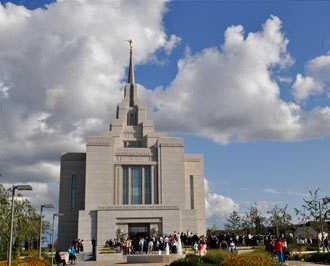
YEV, Ukraine — The first temple lesson learned by LDS Church members attending Sunday's cornerstone ceremony of the Kyiv Ukraine Temple was to share.
You see, the Kyiv temple — the first built by The Church of Jesus Christ of Latter-day Saints in Eastern Europe as well as in the former Soviet Union — is not Ukraine's anymore.
And it doesn't belong to the Latter-day Saints who live in the nine Eastern European nations that comprise the temple district, from Armenia to Moldova and from Russia to Belorussia.
"It is your temple now," said LDS Church President Thomas S. Monson in the opening cornerstone ceremonies of the first of Sunday's three dedication services. "But in a few minutes, we will give it to the Lord."
Ukrainian church members will be pleased to welcome their peers from neighboring nations to visit the church's 134th operating temple worldwide and the 11th on the European continent.
President Monson is the first LDS Church president to visit Ukraine since a 2002 conference at Kiev's Palats Ukraina concert hall featured President Gordon B. Hinckley.
Joining President Monson for the dedication ceremonies were President Dieter F. Uchtdorf, second counselor in the First Presidency; Elder Russell M. Nelson of the Quorum of the Twelve Apostles; Elder William R. Walker of the Quorums of the Seventy and executive director of the church's temple department, the wives of the latter three leaders and the East Europe Area presidency.
Sister Frances Monson did not travel with President Monson.
The Kyiv Ukraine Temple is the latest event in the LDS Church's rapid ascent in Ukraine. The first missionaries arrived in October 1990, the church was formally recognized the next year by the new nation's new government after the 1991 dissolution of the Soviet Union, the Ukraine Kiev Mission was organized in 1992, and the temple was announced in 1998.
Even though the temple was not completed and dedicated for a dozen years after its announcement, no other nation besides the United States has received a temple faster than Ukraine after the introduction of the LDS Church or its missionaries in that country.
Vladimir A. Kanchenko, president of the Kyiv Ukraine Stake since it was organized in 2004, said the new temple will drastically reduce the time and cost for the approximately 31,000 members in the East Europe Area to travel to the temple. Before, they had to spend several days crossing many borders to attend temples in Germany, Sweden, Finland and Switzerland.
"Now all of Ukraine and all of Russia and these other countries can attend the temple as often as they want, not only as often as they can," said Kanchenko, adding that the temple will bless the members with increased knowledge, strength and personal revelation.
Elder Nelson echoed the theme of the temple's accessibility for Eastern European LDS members.
"It will be a temple available to people from Kazakhstan to Kyrgyzstan and, of course, Russia," said Elder Nelson in an interview with the Deseret News and Church News earlier this month.
"The dear people from Russia who wanted to be endowed had to go to Sweden and Finland. This will be a lot easier — politically and economically. It's still a big, long trip for them. But a temple in the former USSR — no one can underestimate the significance of that."
Elder Nelson quoted a statement from then-Elder Boyd K. Packer's apostolic blessing on Ukraine, given in 1991: "We see the day when there will be stakes of Zion set firmly and permanently on the fertile soil of the Ukraine, and in due time, the spires of temples will be seen across this great land."
Currently, the LDS Church has 11,000 members in 64 congregations in Ukraine, including one stake and three missions.
The temple features an exterior of Amarelo Maciera granite, which is light in color and contains quartzite crystals that reflect the sunlight.
The interior design and stained-glass windows suggest a wheat theme, including the plant's upright stem and the diagonal pattern of the kernels.
Labeled the former USSR's "bread basket," the agriculturally rich Ukraine is well-known for its fertile soil and its abundant wheat and grain fields.
The temple's spire stands 42 meters tall — nearly 138 feet high — and is topped with a gilded Angel Moroni statue. Just beneath the sphere upon which the statue stands is a series of flashing red lights that are turned on at night, since the temple is located near a small, local airport.
Sunday's cornerstone ceremony was the only public part of the day's three dedication services for the temple, which is different than church's more common meetinghouses used for public worship and activities.
Following the dedication, only worthy LDS members can enter a temple, where church members believe Jesus Christ's teachings are taught and ordinances for members and their deceased ancestors are performed to unite families for eternity.
"It is a day of freedom — a day you will have all the ordinances of the gospel," said President Monson during the cornerstone ceremony. "It is a time to do the ordinances for your ancestors, for the people who cannot do it for themselves.
"I promise that when you come to the temple, you will have a feeling in your hearts that you have given the greatest gift to them," he continued. "For that is what temple work is all about."
Ukraine gets temple 20 years after introduction of church
After the United States, where the LDS Church was first organized, Ukraine is the country with the least amount of time between the introduction of the church and its missionaries to the completion of an LDS temple.
Ukraine: Church introduced 1990 — Kyiv Temple, 2010 — 20 years
Dominican Republic: Church introduced 1978 — Santo Domingo Temple, 2000 — 22 years
Philippines: Church introduced 1961 — Manila Temple, 1984 — years
Ghana: Church introduced 1978 — Accra Temple, 2004 — 26 years